Why does sheet size matter in heavy-gauge thermoforming?
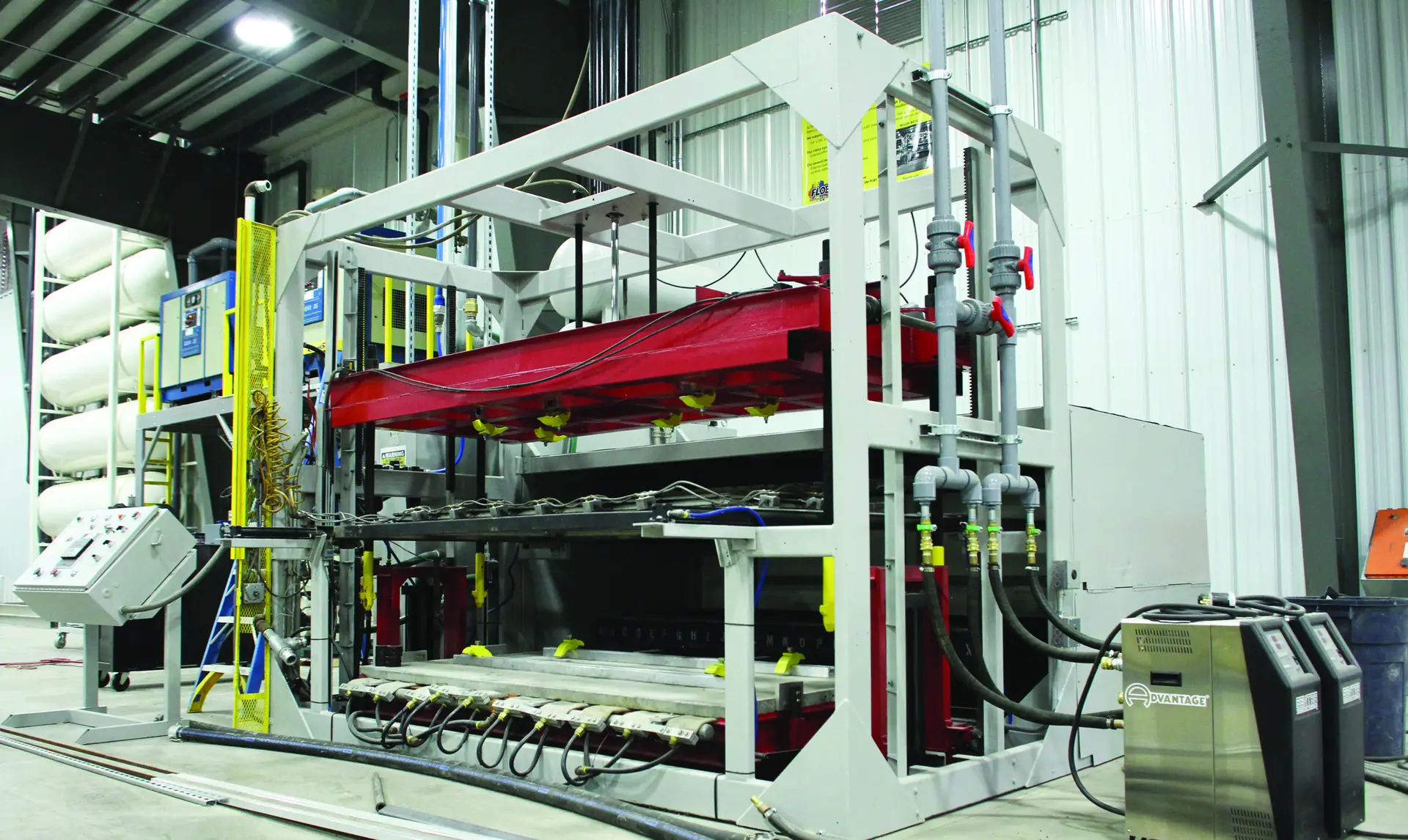
Larger sheet size lets a single formed part replace what would otherwise be a multi-piece assembly, removing seams, fasteners, and assembly labor. ThermoFloe's AVT 3-station rotary forms sheet up to 10 ft by 24 ft at 6 ft draw and .600 in gauge — the largest machine of its kind in the world.
How a 3-station rotary works
A rotary thermoformer mounts three clamp frames on a turntable that indexes through fixed stations: load and unload, heat, and form. While one sheet forms, the next is heating and a finished part is being unloaded. The three operations run in parallel instead of in sequence, which is what gives a rotary its throughput at large size.
Why 10 by 24 feet changes the part
Sheet size sets the ceiling on a single formed part. At 10 by 24 feet, a full equipment cab panel, a long aero fairing, or a one-piece RV cap becomes a single part instead of a stitched-together assembly. Every seam you remove is a fastener, a gasket, a tolerance stack, and an assembly step removed with it.
Draw depth and gauge
A 6-foot draw depth means deep, three-dimensional parts — not just shallow trays. Combined with .600-inch starting gauge, the machine forms parts thick and deep enough to carry structural load and replace metal and fiberglass outright.
What scale really buys
The value is not bragging rights on machine size. It is that an OEM can consolidate parts, cut assembly cost, and improve fit by forming big — and do it at production throughput because the rotary cycle keeps three parts moving at once.