Secondary
Operations
Forming is half the job. ThermoFloe trims, finishes, assembles, and packages in-house, so what leaves the floor is a finished, production-ready component — not just a formed part.
What are secondary operations in thermoforming?
Secondary operations are everything that happens after a part is formed: trimming, machining, finishing, assembly, and packaging. ThermoFloe runs 5-axis and 4-axis CNC trimming, robotic finishing, hardware and component assembly, and packaging under one roof, so OEM parts ship production-ready rather than as raw formed blanks.
Secondary Operations, explained
A formed part still needs its perimeter and openings trimmed, its edges finished, inserts and hardware installed, and the assembly inspected and packaged. Outsourcing those steps adds freight, lead time, and quality risk at every handoff. ThermoFloe keeps them in-house.
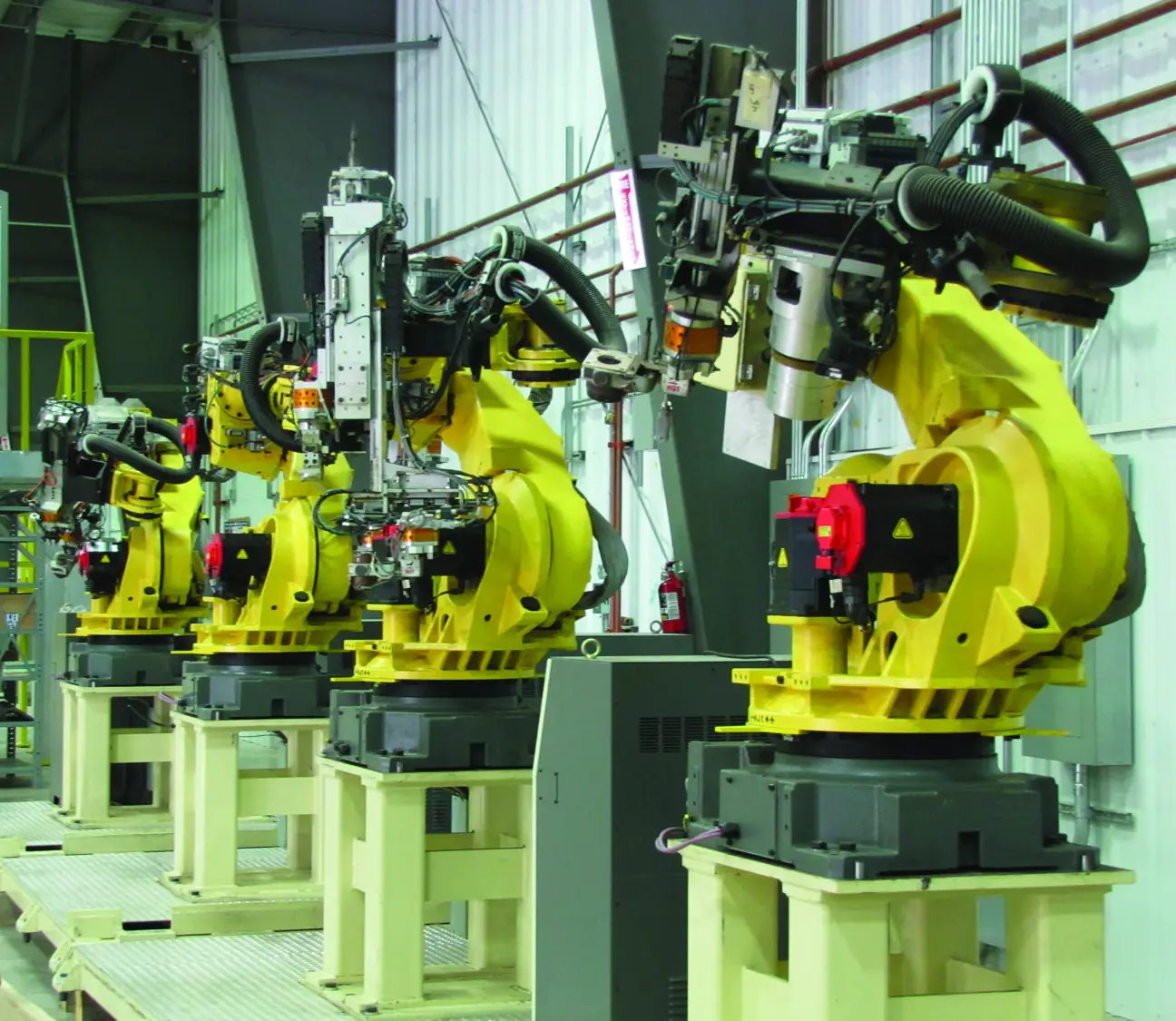
5-axis and 4-axis CNC machining trims and routes complex geometry to print. Robotic cells handle repetitive trim and finishing at production rate. Assembly stations add fasteners, bonded components, gaskets, and electronics, and the finished component is inspected, packaged, and — where required — drop-shipped to the line.
Choosing the right process
Consolidating secondary operations under the forming roof removes the hidden costs of a multi-vendor supply chain.
Explore the rest of the floor
Heavy-Gauge Vacuum Forming
Pressure-assisted vacuum forming for OEM parts too big, too thick, or too deep for anyone …
Heavy-Gauge Pressure Forming
When the part needs sharp detail, defined texture, and tight tolerances without injection-…
In-House Tooling
Tooling is the long pole in most thermoforming programs. ThermoFloe mills prototype tools …
Questions OEM engineers ask
What secondary operations do you run in-house?
5-axis and 4-axis CNC trimming and machining, robotic trim and finishing, edge finishing, hardware and component assembly, bonding, inspection, and packaging.
Why does in-house finishing matter for OEM programs?
Every outsourced step adds freight, lead time, and a quality handoff. Keeping trim, finishing, and assembly under the forming roof shortens lead time and puts one supplier on the hook for the finished part.
Can you assemble hardware, inserts, and electronics into the part?
Yes. Assembly stations install fasteners, bonded components, gaskets, and customer-supplied or sourced hardware, delivering a finished sub-assembly rather than a bare formed part.
Do you package and drop-ship to our line?
Yes. Parts are inspected, packaged to spec, and drop-shipped directly to the production line or distribution point when the program requires it.
How do you hold trim accuracy on large parts?
5-axis CNC trimming references the formed part to fixture datums, holding repeatable trim and hole position across large-format geometry that manual routing cannot match.
Send us the part. We'll tell you how to build it.
Upload your drawing or describe the program. NDA-friendly. We review every RFQ ourselves — response within 1 business day.